
What Critical Factors Influence Quotations from a Peptide Facility During Large-Scale Commercial Mass Production?
In the supply chain management of peptide raw materials, moving from small-scale R&D to large-scale commercial mass production shifts the underlying cost structures and pricing logic fundamentally. For procurement professionals, understanding how a peptide facility calculates its quotations during large-scale manufacturing is essential for conducting more rational commercial negotiations and achieving better cost control. During the commercial mass-production phase, the final quotation is primarily determined by the following critical factors:
1. Amino Acid Sequence Length and the Choice of Synthesis Route
The molecular structure of a peptide is the underlying logic that dictates its core cost.
Sequence Length and Yield: The longer the peptide chain, the more synthesis steps are required. Because no single coupling step can achieve an absolute 100% yield, the overall cumulative yield decreases exponentially as the steps multiply. Long-chain peptides mean the facility must invest multiple times the volume of starting raw materials to yield the equivalent amount of finished product, which drives up the quote significantly.
Synthesis Strategy: For mass production, does the facility utilize traditional Solid-Phase Peptide Synthesis (SPPS), more cost-effective Liquid-Phase Peptide Synthesis (LPPS), or a convergent fragment condensation strategy? Different process routes consume vastly different quantities of organic solvents and protected amino acids, directly impacting material cost overheads.
2. Purity Requirements and Media Consumption in Industrial Purification (Prep-HPLC)
During the laboratory R&D phase, purification costs are relatively negligible due to the small quantities involved. However, at the hundred-kilogram or ton-scale mass-production level, purification often becomes one of the most cost-intensive stages.
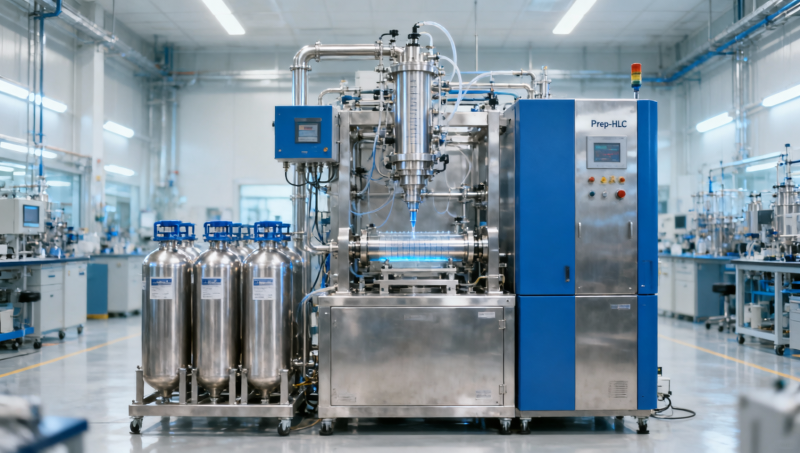
The core manufacturing costs lie in the packing media degradation of industrial-grade Preparative High-Performance Liquid Chromatography (Prep-HPLC) systems, the high consumption of high-purity organic solvents (such as acetonitrile), and electricity usage. If a client increases their purity requirement from 95% to over 98%, the facility may lose a massive percentage of the target peptide in the purification cutting process just to eliminate adjacent impurity peaks. This high loss rate is directly factored into the premium of the final quotation.
3. Complexity of Salt Conversions and Post-Processing Operations
Before shipment, synthesized peptides usually need to be converted into specific salt forms (such as acetate, hydrochloride, or free base) to meet the solubility and stability requirements of the final formulation.
Certain specialized salt conversions—such as performing multiple ion exchanges to completely remove trifluoroacetate (TFA) salts—are procedurally tedious, take longer processing cycles, and can easily cause damage to chromatography columns. Furthermore, during large-scale lyophilization, the chamber occupancy time of the freeze-dryers (which can last for several days) represents a fixed utility and depreciation cost that cannot be ignored.
4. Batch Size per Production Run and Equipment Utilization Efficiency
The core advantage of commercial mass production lies in economies of scale. If a buyer's total annual demand is large but they require the facility to split production into numerous small batches, the fixed costs of equipment cleaning validation, initial material charging losses, and comprehensive quality control (QC) testing for every single batch cannot be effectively diluted. Conversely, if the batch size per single run is large and equipment utilization is maximized, the facility can significantly lower its unit fixed costs, thereby offering a far more competitive quotation.
In summary, quotations for mass-produced peptides are the result of a comprehensive actuarial calculation combining chemical synthesis efficiency, industrial separation technology, and production scheduling engineering. By optimizing purity specifications and reasonably structuring batch sizes, procurement teams can work collaboratively with facilities to achieve the most optimized cost structure.